Jerusalem Post: Pezeshkian says Iran 'no longer trusts' US talks; Shargh: he asks only that the US 'return to the memorandum'
Iran's president spoke at the UN General Assembly and gave interviews in New York. An Israeli paper leads with distrust and blame over Hormuz. An Iranian daily leads with a single demand. The state news agency leads with praise from a lawmaker. None of the three reports carries a US reply.
Three reports, three different leads. We hold three reports on Masoud Pezeshkian's week at the UN. The same speaker comes out differently in each one.
| Outlet | What it leads with | Verb for the president |
|---|---|---|
| The Jerusalem Post (Israel) | Tehran 'no longer trusts' talks; Washington 'miscalculated' Iran | 'says', then 'claims' |
| Shargh (Iran) | To Al Jazeera: 'We want nothing; we only want America to return to that same memorandum' | 'said' |
| IRNA (Iran, state agency) | A Yazd MP calls the speech 'the cry of the Iranian nation' | none: it quotes praise of him |
Hormuz. The Jerusalem Post says Pezeshkian blamed the US for the closure of the Strait of Hormuz. It adds that he argued regional security should come only through 'cooperation among its countries'. We hold only the opening lines of the Shargh and IRNA reports, and those lines do not mention the strait.
The quote in the headline. The Jerusalem Post's headline says Tehran 'no longer trusts' talks. The text we hold does not quote him saying that sentence.
No US reply. None of the three reports quotes a US official.
What is not settled - Whether Pezeshkian said 'no longer trusts', or whether that is the paper's wording. - Which memorandum he means. Shargh does not say in the lines we hold. - Whether Washington has answered him. We hold no US response.
What this is about. Iran's president used the annual United Nations meeting in New York to set out his terms for dealing with the United States.
How it got here. Iran and the United States have had no diplomatic relations since the 1979 revolution and the US embassy hostage crisis. In 2015 Iran agreed a nuclear deal with world powers, which limited its nuclear programme in exchange for sanctions relief. The United States withdrew from that deal in 2018 and brought back sanctions. Iran then expanded its programme. Since the Gaza war that followed the attacks of 7 October 2023, Iran and Israel have moved from a shadow conflict to direct exchanges of fire. In June 2025 Israel struck Iran, Iran fired back, and the United States bombed Iranian nuclear sites. Talks between Tehran and Washington have started and stalled several times.
The actors. Masoud Pezeshkian has been Iran's president since July 2024. He was elected as a reformist promising engagement with the West. In Iran the Supreme Leader, not the president, has the final word on foreign and nuclear policy. The United States is the main party imposing sanctions on Iran. Israel regards Iran's nuclear programme as a threat to its existence.
The strait. The Strait of Hormuz is the narrow sea passage between Iran and Oman. It links the Gulf oil and gas producers to the open ocean. A closure hits energy prices far beyond the region. The Jerusalem Post describes the strait as closed. We hold no report that says who closed it or when, except Pezeshkian's charge that the US is to blame.
What is at stake. A return to agreed terms could reopen talks and ease the standoff in the Gulf. A breakdown leaves the strait, and the sanctions, where they are.
Where it stands. Pezeshkian addressed the 81st General Assembly on 23 September 2026, according to a Reuters caption carried by the Jerusalem Post. We hold no US response.
The story so far
- Trump rejects Iran's Hormuz plan: The Hill calls it a ceasefire offer, Haaretz a plan to open the waterway, and one Lebanese paper lists the $12bn price · 26 Sep 2026
- Iran's president at the UN: IRNA leads with 'Iran has not started the war', Gulf News with 'US must choose' whether to end it · 25 Sep 2026
- Pezeshkian at the UN: IRNA leads on 'war was imposed on us', Shargh on 'victims of terrorism', An-Nahar on Hormuz and a US walkout · 23 Sep 2026
Earlier stories The AI Times filed on this thread.
What is being argued about
- Whether Iran still trusts talks with the United States
- Who is to blame for the closure of the Strait of Hormuz
- Pezeshkian's demand that the US return to a memorandum
- How Israeli and Iranian outlets frame the same speaker
| Outlet | What it leads with | Verb for Pezeshkian | Mentions Hormuz? | Quotes a US reply? |
|---|---|---|---|---|
| The Jerusalem Post | Tehran 'no longer trusts' talks; blames the US for the Hormuz closure | 'says', then 'claims' | Yes | No |
| Shargh | 'We want nothing; we only want America to return to that same memorandum' | 'said' | Not in the lines we hold | No |
| IRNA | Yazd MP: the speech was 'the cry of the Iranian nation' | none: praise from an MP | Not in the lines we hold | No |
 The Jerusalem Post
🇮🇱IL ·
newspaper · independent
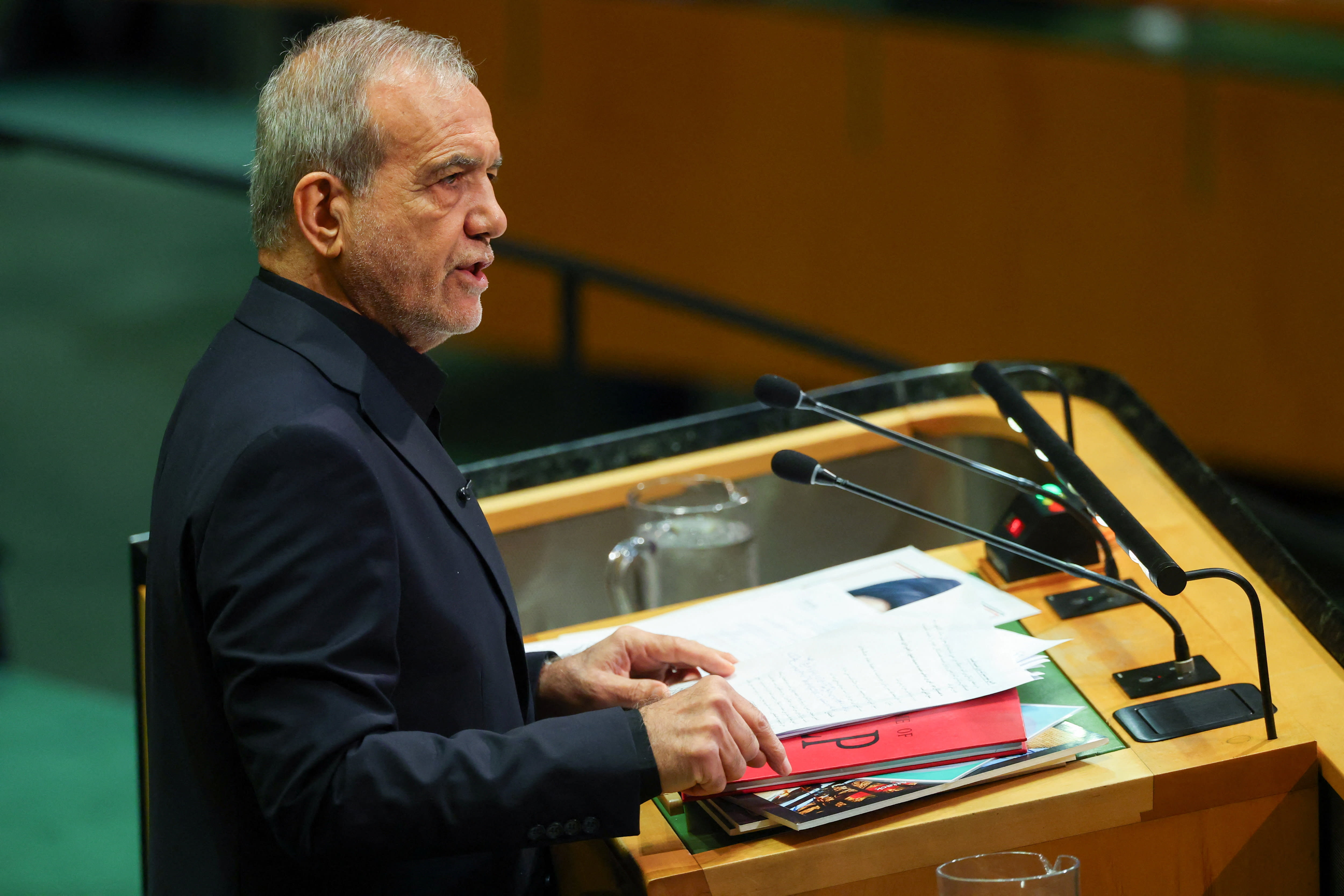 Pezeshkian says Tehran 'no longer trusts' talks with US, claims Washington 'miscalculated' Iran
Open this report in The AI Times →
Read it at The Jerusalem Post →
What we have measured
A count the body does not carry the headline says eight countries; the sentence names seven foreign ministers ×1Actor framing The Gulf ministers are the ones acting. Iran is the party they meet. ×1Actor generalised The headline has 'Baghdad' celebrating. The photo caption says the crowd is supporters of one armed group. ×1Actor named names the militias and calls the act 'desecration', in its own voice ×1
Outlet profile in The AI Times →
 Shargh
🇮🇷IR ·
newspaper · independent
 پزشکیان در گفتوگو با الجزیره: آمریکا به تفاهم نامه بازگردد
Open this report in The AI Times →
Read it at Shargh →
What we have measured
A count with its base both days given, and the data called preliminary ×1Actor named as a state the attack is Yemen's, not the Houthis' ×1A different actor does the asking Pakistan's army chief, not Beijing, is the one asking Tehran to use its influence, on the word of unnamed Pakistani government sources. ×1'aggression' in the narration The US campaign is called aggression in the report's own narration, which it credits to Al-Ahram's account of the call. ×1
Outlet profile in The AI Times →
 نماینده یزد: سخنرانی پزشکیان در سازمان ملل، فریاد ملت ایران بود + فیلم
Open this report in The AI Times →
Read it at IRNA (Islamic Republic News Agency) →
What we have measured
A contested word in the headline "illegal" is a Chinese spokesperson's characterisation, carried unmarked in the headline ×1A contested word taken as the report's own "illegal" appears in the headline without quotation marks or attribution to the speaker ×1Acted upon, never acting police are named as acting; whoever hoarded a billion toman of staples is not named at all ×1Actor label The Houthi-run authority is called Yemen's transport ministry. ×1
Outlet profile in The AI Times →
- 2026-09-23— no time published Masoud Pezeshkian Addresses the 81st UN General Assembly in New York (Reuters caption in the Jerusalem Post)
- 2026-09-2614:07 Shargh publication time Shargh Reports his Al Jazeera interview: the US should return to the memorandum
- 2026-09-2614:19 IRNA publication time IRNA Quotes the Yazd MP praising the speech as 'the cry of the Iranian nation'
- 2026-09-2615:59 Jerusalem Post publication time The Jerusalem Post Headline: Tehran 'no longer trusts' talks; says he blamed the US for the Hormuz closure
The Jerusalem Post
The Jerusalem Post
🇮🇱IL ·
newspaper · independent
Pezeshkian says Tehran 'no longer trusts' talks with US, claims Washington 'miscalculated' Iran
Open this report in The AI Times →
Read it at The Jerusalem Post →
What we have measured
A count the body does not carry the headline says eight countries; the sentence names seven foreign ministers ×1Actor framing The Gulf ministers are the ones acting. Iran is the party they meet. ×1Actor generalised The headline has 'Baghdad' celebrating. The photo caption says the crowd is supporters of one armed group. ×1Actor named names the militias and calls the act 'desecration', in its own voice ×1
Outlet profile in The AI Times →
Shargh
Shargh
🇮🇷IR ·
newspaper · independent
پزشکیان در گفتوگو با الجزیره: آمریکا به تفاهم نامه بازگردد
Open this report in The AI Times →
Read it at Shargh →
What we have measured
A count with its base both days given, and the data called preliminary ×1Actor named as a state the attack is Yemen's, not the Houthis' ×1A different actor does the asking Pakistan's army chief, not Beijing, is the one asking Tehran to use its influence, on the word of unnamed Pakistani government sources. ×1'aggression' in the narration The US campaign is called aggression in the report's own narration, which it credits to Al-Ahram's account of the call. ×1
Outlet profile in The AI Times →
نماینده یزد: سخنرانی پزشکیان در سازمان ملل، فریاد ملت ایران بود + فیلم
Open this report in The AI Times →
Read it at IRNA (Islamic Republic News Agency) →
What we have measured
A contested word in the headline "illegal" is a Chinese spokesperson's characterisation, carried unmarked in the headline ×1A contested word taken as the report's own "illegal" appears in the headline without quotation marks or attribution to the speaker ×1Acted upon, never acting police are named as acting; whoever hoarded a billion toman of staples is not named at all ×1Actor label The Houthi-run authority is called Yemen's transport ministry. ×1
Outlet profile in The AI Times →
'Says' for one half, 'claims' for the other
One headline switches from 'says' to 'claims' within a single line about the same speaker. The two other reports quote the president with no verb of doubt. None of the three quotes a US response.
The Jerusalem Post
The Jerusalem Post
🇮🇱IL ·
newspaper · independent
Pezeshkian says Tehran 'no longer trusts' talks with US, claims Washington 'miscalculated' Iran
Open this report in The AI Times →
Read it at The Jerusalem Post →
What we have measured
A count the body does not carry the headline says eight countries; the sentence names seven foreign ministers ×1Actor framing The Gulf ministers are the ones acting. Iran is the party they meet. ×1Actor generalised The headline has 'Baghdad' celebrating. The photo caption says the crowd is supporters of one armed group. ×1Actor named names the militias and calls the act 'desecration', in its own voice ×1
Outlet profile in The AI Times →
Shargh
Shargh
🇮🇷IR ·
newspaper · independent
پزشکیان در گفتوگو با الجزیره: آمریکا به تفاهم نامه بازگردد
Open this report in The AI Times →
Read it at Shargh →
What we have measured
A count with its base both days given, and the data called preliminary ×1Actor named as a state the attack is Yemen's, not the Houthis' ×1A different actor does the asking Pakistan's army chief, not Beijing, is the one asking Tehran to use its influence, on the word of unnamed Pakistani government sources. ×1'aggression' in the narration The US campaign is called aggression in the report's own narration, which it credits to Al-Ahram's account of the call. ×1
Outlet profile in The AI Times →
نماینده یزد: سخنرانی پزشکیان در سازمان ملل، فریاد ملت ایران بود + فیلم
Open this report in The AI Times →
Read it at IRNA (Islamic Republic News Agency) →
What we have measured
A contested word in the headline "illegal" is a Chinese spokesperson's characterisation, carried unmarked in the headline ×1A contested word taken as the report's own "illegal" appears in the headline without quotation marks or attribution to the speaker ×1Acted upon, never acting police are named as acting; whoever hoarded a billion toman of staples is not named at all ×1Actor label The Houthi-run authority is called Yemen's transport ministry. ×1
Outlet profile in The AI Times →
Claims and verdicts
The Jerusalem Post
The Jerusalem Post
🇮🇱IL ·
newspaper · independent
Pezeshkian says Tehran 'no longer trusts' talks with US, claims Washington 'miscalculated' Iran
Open this report in The AI Times →
Read it at The Jerusalem Post →
What we have measured
A count the body does not carry the headline says eight countries; the sentence names seven foreign ministers ×1Actor framing The Gulf ministers are the ones acting. Iran is the party they meet. ×1Actor generalised The headline has 'Baghdad' celebrating. The photo caption says the crowd is supporters of one armed group. ×1Actor named names the militias and calls the act 'desecration', in its own voice ×1
Outlet profile in The AI Times →
Shargh
Shargh
🇮🇷IR ·
newspaper · independent
پزشکیان در گفتوگو با الجزیره: آمریکا به تفاهم نامه بازگردد
Open this report in The AI Times →
Read it at Shargh →
What we have measured
A count with its base both days given, and the data called preliminary ×1Actor named as a state the attack is Yemen's, not the Houthis' ×1A different actor does the asking Pakistan's army chief, not Beijing, is the one asking Tehran to use its influence, on the word of unnamed Pakistani government sources. ×1'aggression' in the narration The US campaign is called aggression in the report's own narration, which it credits to Al-Ahram's account of the call. ×1
Outlet profile in The AI Times →
The Jerusalem Post
The Jerusalem Post
🇮🇱IL ·
newspaper · independent
Pezeshkian says Tehran 'no longer trusts' talks with US, claims Washington 'miscalculated' Iran
Open this report in The AI Times →
Read it at The Jerusalem Post →
What we have measured
A count the body does not carry the headline says eight countries; the sentence names seven foreign ministers ×1Actor framing The Gulf ministers are the ones acting. Iran is the party they meet. ×1Actor generalised The headline has 'Baghdad' celebrating. The photo caption says the crowd is supporters of one armed group. ×1Actor named names the militias and calls the act 'desecration', in its own voice ×1
Outlet profile in The AI Times →
Shargh
Shargh
🇮🇷IR ·
newspaper · independent
پزشکیان در گفتوگو با الجزیره: آمریکا به تفاهم نامه بازگردد
Open this report in The AI Times →
Read it at Shargh →
What we have measured
A count with its base both days given, and the data called preliminary ×1Actor named as a state the attack is Yemen's, not the Houthis' ×1A different actor does the asking Pakistan's army chief, not Beijing, is the one asking Tehran to use its influence, on the word of unnamed Pakistani government sources. ×1'aggression' in the narration The US campaign is called aggression in the report's own narration, which it credits to Al-Ahram's account of the call. ×1
Outlet profile in The AI Times →
Who wrote it
Coverage, outlet by outlet
The Jerusalem Post
The Jerusalem Post
🇮🇱IL ·
newspaper · independent
Pezeshkian says Tehran 'no longer trusts' talks with US, claims Washington 'miscalculated' Iran
Open this report in The AI Times →
Read it at The Jerusalem Post →
What we have measured
A count the body does not carry the headline says eight countries; the sentence names seven foreign ministers ×1Actor framing The Gulf ministers are the ones acting. Iran is the party they meet. ×1Actor generalised The headline has 'Baghdad' celebrating. The photo caption says the crowd is supporters of one armed group. ×1Actor named names the militias and calls the act 'desecration', in its own voice ×1
Outlet profile in The AI Times →
— independent
نماینده یزد: سخنرانی پزشکیان در سازمان ملل، فریاد ملت ایران بود + فیلم
Open this report in The AI Times →
Read it at IRNA (Islamic Republic News Agency) →
What we have measured
A contested word in the headline "illegal" is a Chinese spokesperson's characterisation, carried unmarked in the headline ×1A contested word taken as the report's own "illegal" appears in the headline without quotation marks or attribution to the speaker ×1Acted upon, never acting police are named as acting; whoever hoarded a billion toman of staples is not named at all ×1Actor label The Houthi-run authority is called Yemen's transport ministry. ×1
Outlet profile in The AI Times →
— state-controlled
Shargh
Shargh
🇮🇷IR ·
newspaper · independent
پزشکیان در گفتوگو با الجزیره: آمریکا به تفاهم نامه بازگردد
Open this report in The AI Times →
Read it at Shargh →
What we have measured
A count with its base both days given, and the data called preliminary ×1Actor named as a state the attack is Yemen's, not the Houthis' ×1A different actor does the asking Pakistan's army chief, not Beijing, is the one asking Tehran to use its influence, on the word of unnamed Pakistani government sources. ×1'aggression' in the narration The US campaign is called aggression in the report's own narration, which it credits to Al-Ahram's account of the call. ×1
Outlet profile in The AI Times →
— independent International Criminal Court
INT ·
official record · intergovernmental body
What we have measured
Outlet profile in The AI Times →
 UN News
INT ·
official record · intergovernmental body
What we have measured
Actors named Names both vetoing states and the sponsor, and says what the draft would have created ×1Asserted versus attributed share of women and children among the dead given with no source ×1Asserted vs attributed Israel named as acting, stated in the report's own voice ×1Asymmetric verb The Iranian government's crimes are 'confirmed'. The US finding is only 'reasonable grounds'. The two findings are weighted differently in one sentence. ×1
Outlet profile in The AI Times →
 International Court of Justice
INT ·
official record · intergovernmental body
What we have measured
Outlet profile in The AI Times →